Dear All,
Please note that works will be taking place under a full road closure, starting on Monday 24th February 2025 to (and including) Friday 28th February 2025.
The road will be closed between 9:00 and 15:30 each day.
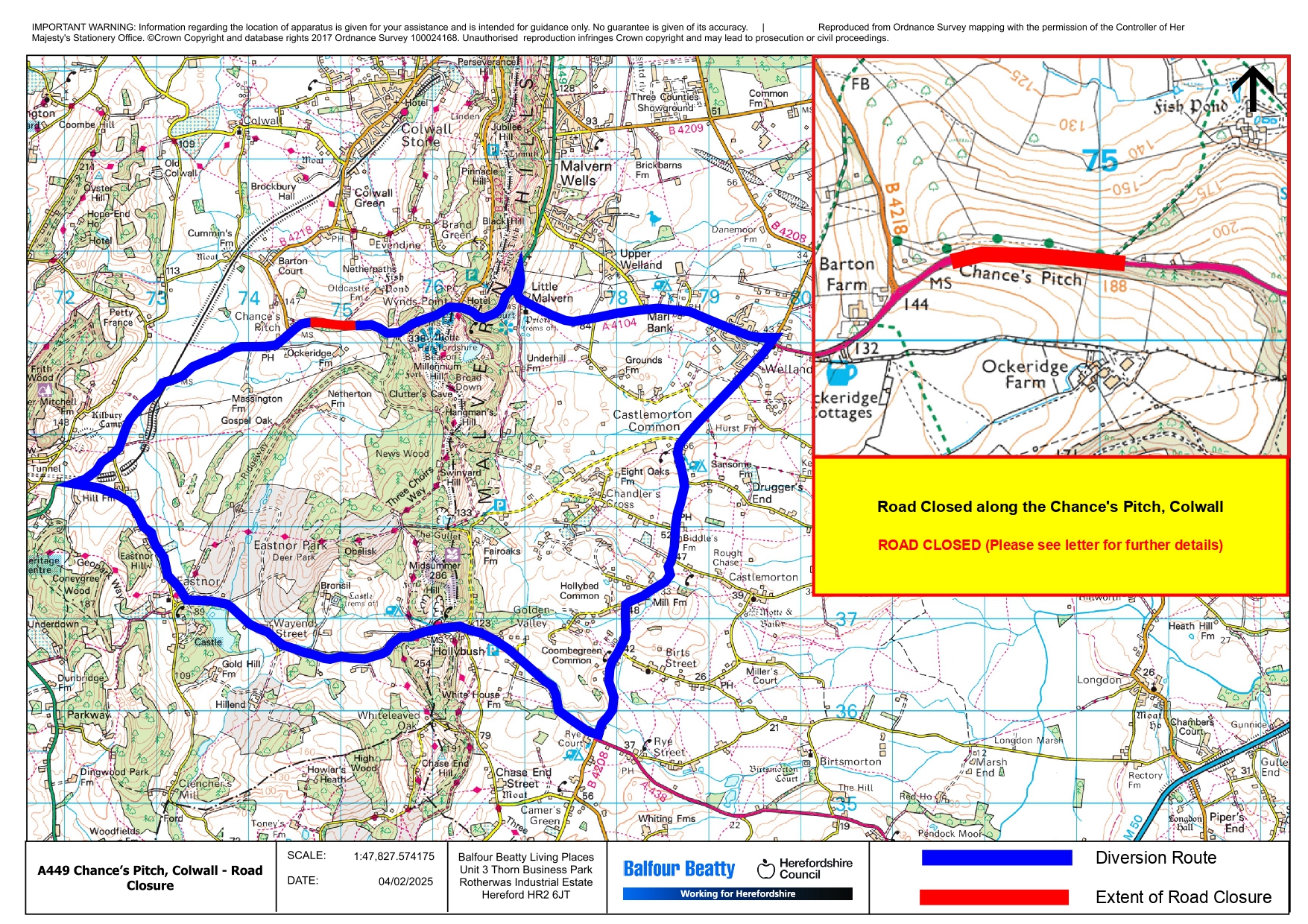
The fully signed diversion route is via the A449, A438, B4208 and A4104 and vice versa – please see map below.
The works will be carried out for essential tree removal due to ash dieback disease (more information below).
Essential vehicular access to properties will be provided, although there may be times when there will be delays due to safety concerns. You will be able to get help and guidance from the dedicated marshals on site.
The programme of work may change in certain circumstances, such as severe weather. This may happen at short notice and without further notification. All changes will be highlighted on the advance warning signs, which you’ll find onsite at the roadworks. For the most up to date information on roadworks across the county, please visit https://one.network. You can also follow on Twitter via @HfdsStreets and Facebook via Herefordshire Highways.
If you have any questions about these works, please use the Contact Us form on the Herefordshire Council website. This can be found at https://www.herefordshire.gov.uk/council/contact-us. Alternatively, call on 01432 261800.
Scan the QR code to find out more about this work.

ASH DIEBACK DISEASE
Herefordshire Council is committed to addressing the lethal and incurable disease affecting our county’s trees. We have allocated £315,000 over the next four years to cope with ash dieback, which was first identified in the UK in 2012. This disease can slowly kill trees, lead to the shedding of limbs, or even cause entire trees to fall. Please be assured that we undertake surveys before any works are carried out to ensure we do not disturb any nesting birds or other protected wildlife.
What are the symptoms of ash dieback?
- Dead branches
- Leaves turn black and hang on the tree
- Stems have dark, diamond-shaped marks where leaves were attached
- Leaves get dark patches in summer, then wilt and turn black
- Leaves might fall off early
- Shoots and leaves die back in summer
- Dark, diamond-shaped lesions where branches meet the trunk
- Inner bark under lesions looks brownish grey
When ash trees are stressed, they might grow new shoots on their trunks. They can also drop branches or fall over. Symptoms are easier to see in mid to late summer when trees have all their leaves. In autumn, it’s harder to spot because leaves change colour and fall off. Once infected, the disease is usually fatal, either directly or by making the tree more vulnerable to other pests like honey fungus, which can cause root rot and make the tree fall.
How does it spread?
The disease spreads in two main ways:
- Locally by Wind: The fungus grows on last year’s fallen leaves and releases spores between June and September. These spores are carried by the wind over 10 miles and can land on healthy trees, infecting them if enough spores settle.
- Over Long Distances: The disease can also spread by moving infected ash plants to new areas.
Simple steps can reduce the risk of spores being spread:
- Clean your shoes before and after visiting a woodland or countryside.
- Avoid taking cuttings or plant material from the countryside.
- Wash your car or bike wheels to remove mud or plant material.
What impact will ash dieback have? It’s difficult to say how badly Herefordshire’s ash trees will be affected by the disease. The prediction is we’re going to lose up to 95% of our ash trees in the UK. This is going to have a devastating impact on the landscape, as well as a major loss in connections between habitats as we lose hedges.
Herefordshire Council are responsible for trees and other vegetation on land owned by the council. This includes trees on our highways which are maintained by Balfour Beatty Living Places through the Public Realm service.